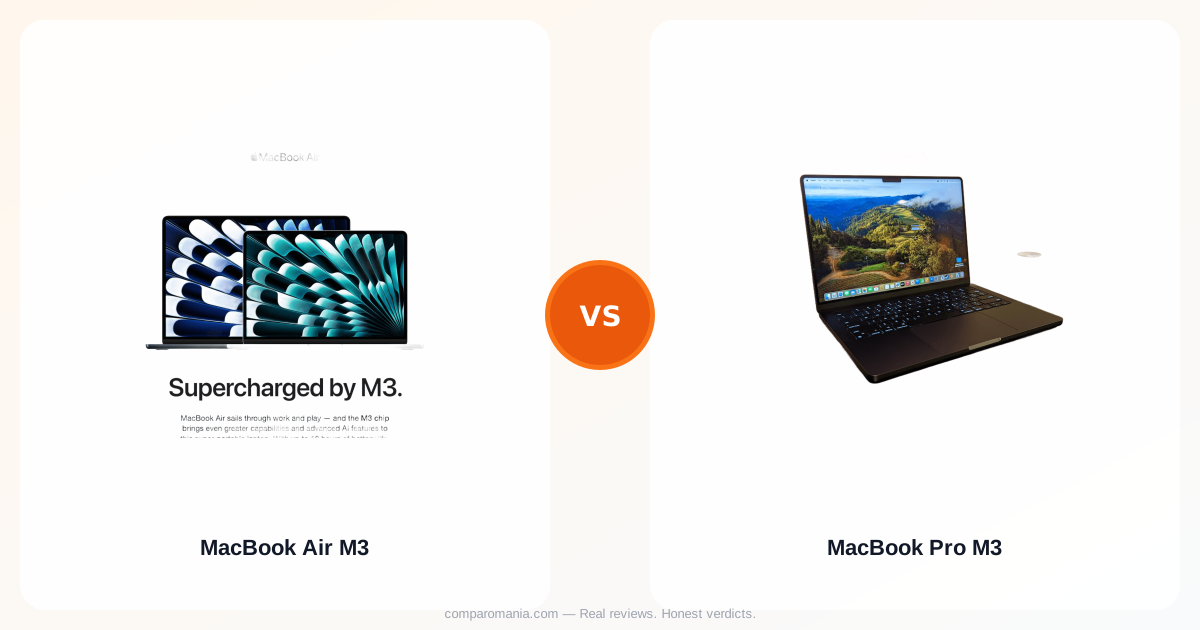
Price gap that feels bigger than it is
The MacBook Air M3 starts at $1,099 for 8GB RAM and 256GB storage. The MacBook Pro M3 starts at $1,599 for the same specs. That $500 difference sounds significant until you realize most people need more than 256GB storage anyway.
Bump both to 512GB and the gap shrinks to $400 ($1,299 vs $1,699). Add 16GB RAM to handle multiple browser tabs without slowdown and you're looking at $1,499 vs $1,899 — a $400 difference for what many users actually buy.
Apple's trade-in program typically offers $200-400 for a 3-year-old MacBook, regardless of which model. The resale value difference between Air and Pro models of the same generation usually hovers around $150-200 after two years.
Performance that converges where it matters
Both laptops run the same M3 chip. Geekbench 6 scores show the MacBook Pro M3 scoring around 3,000 single-core and 11,800 multi-core. The MacBook Air M3 hits 3,000 single-core and 11,500 multi-core. That 2.5% difference disappears in daily use.
The Pro's active cooling lets it sustain peak performance longer. Export a 10-minute 4K video and the Pro finishes in 4 minutes while the Air takes 5-6 minutes after thermal throttling kicks in. But for most work — web browsing, office apps, light photo editing — both machines feel identical.
Code compilation shows the clearest difference. Xcode builds that take 2 minutes on the Pro stretch to 3-4 minutes on the Air once it heats up. If you're building software professionally, those extra minutes accumulate into hours weekly.
Design choices with daily consequences
The MacBook Air M3 weighs 2.7 pounds. The MacBook Pro M3 weighs 3.0 pounds. That 0.3-pound difference becomes noticeable after carrying either laptop in a bag for hours, but not in the way you'd expect.
The Air's wedge shape makes it feel lighter than its weight suggests. The Pro's uniform thickness distributes weight more evenly in a backpack. User reports consistently mention the Air causing more shoulder fatigue during long carries, despite being lighter on paper.
Both have identical 13.6-inch Liquid Retina displays, but the Pro includes a Touch Bar — or did until Apple removed it in late 2023. Current Pro models use function keys like the Air.
The Pro offers better speakers and microphones. Video calls sound noticeably clearer on the Pro, according to multiple user comparisons on Reddit and tech forums. The difference matters if you spend hours in Zoom meetings.
Features that separate daily workflows
The MacBook Pro M3 includes an additional USB-C port (three total vs two on the Air). That third port eliminates the daily dance of unplugging your charger to connect an external drive or second monitor.
Both support one external 6K display, but the Pro can drive a second 5K display simultaneously. The Air maxes out at one external monitor plus the built-in screen. For desk setups with multiple monitors, this limitation hits harder than expected.
Battery life shows minimal difference in real-world testing. Both deliver 12-15 hours of web browsing and document editing. Video streaming drains both to about 10-12 hours. The Pro's larger battery balances out against its higher power consumption.
The Air includes MagSafe charging plus two USB-C ports. The Pro includes MagSafe plus three USB-C ports. Both charge from 0-50% in roughly 30 minutes.
Long-term costs most reviews skip
Here's what nobody mentions clearly: Apple's unified memory architecture means you can't upgrade RAM after purchase. Buy 8GB now, you're stuck with 8GB forever. Both laptops offer identical upgrade pricing — $200 for 16GB, $400 for 24GB.
Repair costs favor the Air slightly. Screen replacements run $320-380 for the Air vs $380-420 for the Pro through Apple's service network. Logic board repairs cost roughly the same ($500-600) for both models.
Both laptops typically receive 6-7 years of macOS updates. The M3 chip ensures both will handle future macOS versions equally well through 2030-2031.
AppleCare+ costs $199 for the Air, $249 for the Pro. That $50 difference might influence your decision if you always buy extended warranty coverage.
Professional work reality check
Video editors working with 4K footage see meaningful differences. The Pro sustains full-speed rendering for extended periods while the Air throttles after 10-15 minutes of intensive work. Adobe Premiere Pro users report 20-30% longer export times on the Air for projects over 10 minutes.
Software developers face mixed results. Xcode compilation suffers on the Air during thermal throttling, but most web development work shows no difference. Docker containers and virtual machines run identically on both machines until you're running multiple VMs simultaneously.
Photo editing in Lightroom and Photoshop performs nearly identically on both laptops for typical workflows. The Air only struggles with batch processing of 500+ RAW files or complex multi-layer compositions.