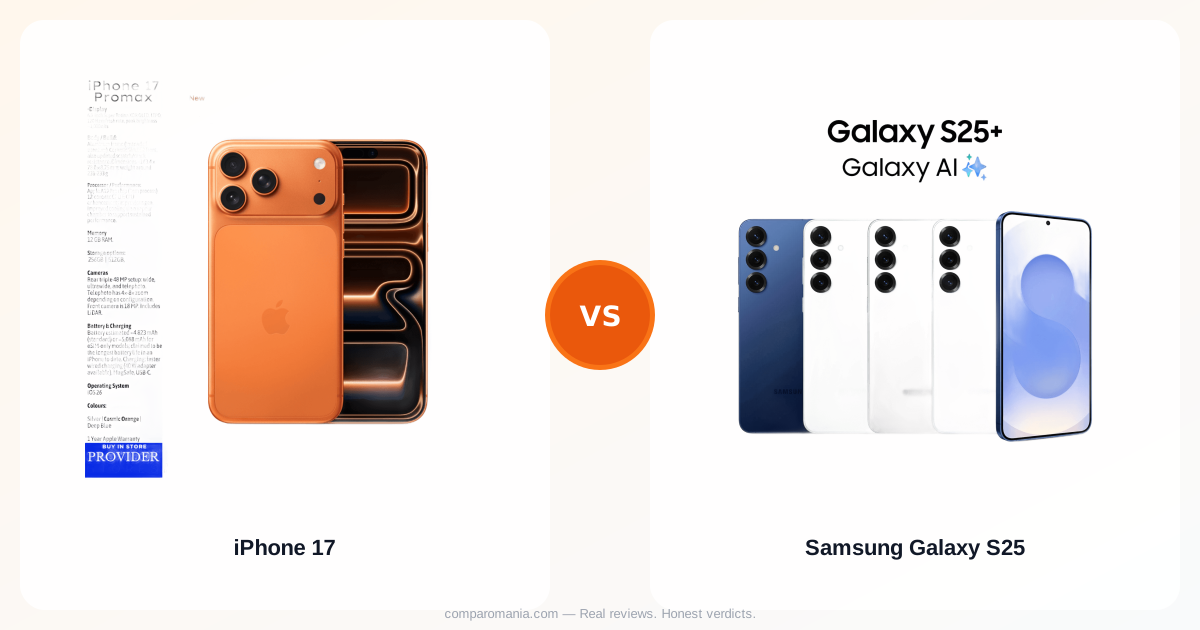
You're standing at a $799 decision and both phones are staring back at you with identical price tags. The Samsung Galaxy S25 launched in February 2025, the iPhone 17 in September 2025. Same starting price, very different phones. That identical sticker is where the similarity ends.
Same price, but not the same deal
Both the iPhone 17 and the Samsung Galaxy S25 start at $799/£799 in their base configurations. But what you get for that money differs immediately at the storage tier. The iPhone 17 starts at $799 with 256GB of storage included. The Galaxy S25 starts at $799.99 for the 128GB model, with the 256GB version costing $859.99. That means, on a like-for-like storage basis, the S25 actually costs $60 more. Not a dealbreaker, but not equal either.
For buyers outside the US, the gap can widen fast. UK pricing starts at £799 for both phones, while Australian pricing for the iPhone 17 starts at AU$1,399. Import markets stretch both prices further — in some regions, neither phone is truly accessible at its headline number.
The chip debate, and why it matters less than you think
PhoneArena's Geekbench 6 tests show the iPhone 17 leading in single-core performance (3,527 vs 3,031), but the Galaxy S25 pulls significantly ahead in multi-core (9,626 vs 8,798), meaning it has more raw throughput for multitasking and heavier workloads.
The iPhone 17 proved more thermally stable under sustained load, with a better low GPU score (3,295 vs 2,500). The Galaxy gives you higher peak performance in ideal conditions, but the iPhone stays cooler and more consistent over long sessions.
For most people buying at this price, the day-to-day gap between these two chips is invisible. Apple's A19 delivers exceptional single-core responsiveness through deep integration between silicon, software, and thermal management — the most useful framing is that the winner depends on whether your priority is maximum parallel compute or maximum sustained responsiveness per watt. If you game hard or run multiple intensive apps simultaneously, the S25 has an edge at peak. If you want consistent smoothness over a two-hour session, the iPhone holds its ground.
The camera gap nobody is saying clearly enough
This is the one. Not a spec caveat, not a footnote — an actual structural problem with the base iPhone that Apple has chosen not to fix.
Samsung has included a telephoto camera on its standard flagships since the Galaxy S10 in 2019. Apple has reserved optically zoomed cameras for the iPhone Pro and Pro Max since the iPhone 11 series that same year. That's six years of the same policy. The iPhone 17 still doesn't have a telephoto lens. Apple is yet to add a dedicated telephoto camera to its non-Pro iPhone — an advantage Samsung has had for years, and now so does Google with the Pixel 10.
The Galaxy S25's telephoto camera supports 3x optical zoom, while the iPhone 17 supports only 2x optical zoom. That 2x on the iPhone 17 is a digital crop from the main sensor — not a dedicated lens, not optical.
Where the iPhone 17 fights back: the iPhone 17 has a 48MP wide and a 48MP ultrawide, and that upgraded ultrawide delivers real photo-taking flexibility, particularly compared to the Galaxy S25's 12MP ultrawide. Close-up and wide shots lean iPhone. Anything at distance leans Samsung. For video, the S25 can shoot 8K at 30fps, while the iPhone 17 tops out at 4K at 30 or 60fps.
The display catch-up that actually changes things
Unlike Samsung, which introduced a relatively incremental update to the standard Galaxy S25 this year, Apple came in with several significant changes to the base iPhone 17 — the most discussed being the long-awaited 120Hz display, something Samsung has offered on standard Galaxy flagships since the Galaxy S20 in 2020.
Five years late is still arriving. The iPhone 17 marks the first time Apple has brought ProMotion 120Hz technology to the standard iPhone lineup. The display also grew from 6.1 inches to 6.3 inches and now reaches 3,000-nit peak outdoor brightness. Apple also added an anti-reflective coating this year, giving it a slight edge outdoors.
The Galaxy S25's 6.2-inch AMOLED display has a 2,340x1,080-pixel resolution and peaks at 2,600 nits. The iPhone 17's 3,000-nit ceiling is the better number in direct sunlight. Samsung's always-on display remains a usability feature Apple hasn't matched on the standard model.
The screens are genuinely close now. The iPhone caught up on refresh rate. Samsung still has always-on.
Battery life and charging: not the same story
The iPhone 17 will easily deliver one to two days of battery on light to medium usage, while the Galaxy S25 will typically last a day with the same usage. Apple hasn't published the exact battery capacity, but the company confirms up to 30 hours of video playback. The Galaxy S25 has a 4,000mAh battery rated for up to 38 hours of talk time.
The iPhone 17 wins on wireless charging speed and overall battery life; the Galaxy S25 wins on wired charging power. Samsung's 25W wired charging is faster than Apple's standard wired charging — but if you primarily charge wirelessly overnight, the iPhone's overall endurance advantage is the more relevant daily number.
Software support, and the hidden cost of choosing wrong
This is where the long-term ownership calculation shifts. The Galaxy S25 ships with Android 15, with Samsung committing to up to 7 major OS upgrades. Apple doesn't publish a fixed number of iOS updates — the track record across past iPhones suggests 6 or more years of software support, often longer.
But the cadence is different. The S25 has received an update to Android 16 and Samsung's One UI 8, which adds AI-powered personalisation and an interface optimised for different form factors. On the other side, iOS 26 looks feature-heavy compared to Samsung's One UI 8.
Owner sentiment on Samsung's update delivery has been fractured. User forums document frustration with rollout timing, particularly for devices not in the S25 generation. There have been complaints about the lack of major hardware improvements in the S25, and some users report that subsequent One UI updates have been relatively dull. Apple's updates land simultaneously on all supported devices, worldwide, on the same day. That consistency has value that doesn't show up in any spec table — but over four years of ownership, it compounds.
Ecosystem and who this phone is actually for
Apple Intelligence in iOS handles summarisation, priority notifications, and image generation locally on-device, while Samsung's Galaxy AI drives translation, generative editing, and live call subtitling via cloud-based processing. Apple leads in device privacy and native AI integration; Samsung leads on real-time translation and editing flexibility but is cloud-reliant.
If you already own a Mac, iPad, or Apple Watch, the iPhone 17 deepens that connection in ways no spec sheet captures — AirDrop, Handoff, iMessage, and Universal Clipboard are genuinely useful daily. If you're on Windows, use Google services, or own Galaxy buds and a Samsung TV, the S25 slots in without friction. While the A19 chip is a capable performer, Samsung arguably does more with its on-device Galaxy AI processing than Apple does with Apple Intelligence currently, and between Galaxy AI and Gemini, the Galaxy S25 has the broader AI feature suite.
Neither ecosystem is wrong. They're just different contracts.