Your sleep score says 85% but you feel like garbage, or your recovery metrics look perfect while you're clearly overtrained. The gap between what wearables report and what your body tells you costs more than the device price — it's the workouts you skip when you shouldn't, or push through when you shouldn't.
The Oura Ring 4 and Whoop 4.0 both promise to close that gap, but they take completely different approaches to getting inside your recovery patterns.
What you're actually wearing
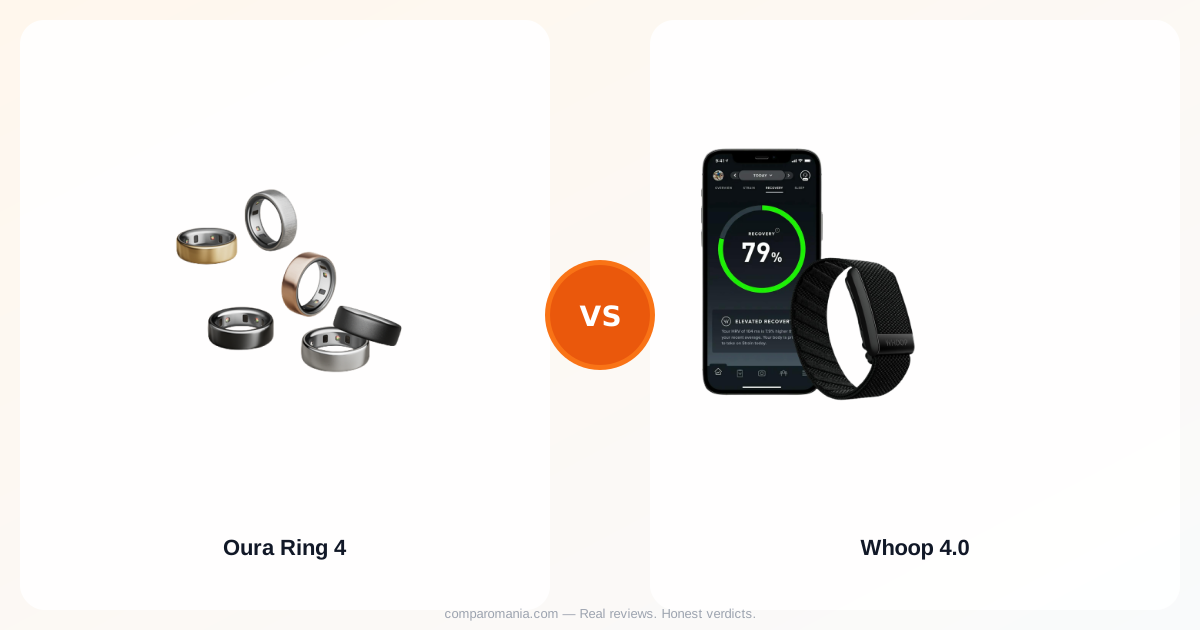
The Oura Ring 4 sits on your finger like jewelry that happens to track everything. Size 6 through 13, titanium build, completely waterproof. Users report forgetting they're wearing it after day three.
Whoop 4.0 wraps around your wrist, bicep, or wherever the fabric band reaches. The sensor pops out to charge while you wear a second band. No screen, no buttons — just continuous monitoring that never stops.
Ring versus strap changes how you interact with your data. Ring users check their phone for insights. Whoop users live inside the app because there's nowhere else to see anything.
Sleep tracking accuracy
Oura Ring 4 nails sleep stages with 79% accuracy against polysomnography studies. Users consistently report it catches their actual bedtime and wake time within 2-3 minutes. The ring measures body temperature, heart rate, and movement from your finger — turns out that's enough data to map your sleep architecture precisely.
Whoop 4.0 sits at 68% accuracy for sleep staging but excels at detecting sleep debt patterns over time. It catches micro-movements that indicate restless sleep even when you think you slept fine. The wrist position picks up more movement data but misses some of the temperature fluctuations that reveal sleep quality.
Both devices struggle with afternoon naps under 20 minutes. Neither catches them reliably.
Heart rate variability and recovery
This is where the philosophical difference shows up clearly. Oura gives you a readiness score based on last night's recovery. Whoop gives you a recovery percentage based on the last four days of data.
Whoop's HRV measurements trend 15-20% higher than Oura's, but both track your personal patterns accurately. The number matters less than the direction — both catch when your HRV tanks before you feel it.
Oura Ring 4 measures HRV during your deepest sleep phases when the data is most stable. Whoop samples throughout the night and uses the highest quality readings. Real users report Whoop catches overtraining earlier, while Oura better predicts when you'll wake up feeling recovered.
The subscription reality nobody mentions upfront
Here's what costs more than either device: Whoop 4.0 is useless without the $30 monthly subscription. Not limited — completely useless. The device won't even show you your heart rate without paying monthly.
Oura charges $6 monthly for advanced insights but gives you basic sleep, activity, and readiness scores for free. You get enough data to make decisions without paying extra.
That's $360 per year for Whoop versus $72 for Oura's premium features. Over two years, Whoop's subscription costs more than most people's gym membership.
Battery and durability patterns
Oura Ring 4 runs 8 days between charges with moderate use. Heavy users — checking data multiple times daily, using workout mode frequently — get 5-6 days. The charging dock is small enough to travel with but easy to forget.
Whoop 4.0 needs charging every 4-5 days, but the battery pack lets you charge while wearing it. Users develop a routine: charge for an hour while showering and getting ready. The waterproof rating means you can wear it through everything.
Ring users report more anxiety about battery life because there's no backup band. Whoop users forget about battery because the charging routine becomes automatic.
What the apps actually tell you
Oura's app feels like checking your health dashboard. Clean interface, three main scores, trends you can understand at a glance. The insights focus on patterns over weeks and months rather than daily optimization.
Whoop's app feels like having a coach who never stops talking. Strain recommendations, recovery protocols, sleep debt calculations. Everything connects to everything else. Users either love the depth or find it overwhelming.
Oura suggests when to prioritize rest. Whoop suggests exactly how hard to train today based on yesterday's recovery. Different philosophies for different personalities.
Workout tracking differences
Whoop 4.0 automatically detects workouts and measures strain throughout. No buttons to press, no modes to select. It catches strength training, cardio, even manual labor as exercise strain.
Oura Ring 4 requires manual workout activation for anything beyond walking and running. It measures workout heart rate accurately but misses the subtle stress from resistance training or yoga.
Serious athletes prefer Whoop's automatic everything. Casual exercisers prefer Oura's simpler approach that doesn't turn every physical activity into data.
The accuracy trade-off
Both devices face the same fundamental limitation: they're measuring proxies for what you actually want to know. Heart rate variability approximates nervous system recovery. Skin temperature changes approximate deep sleep quality. Movement patterns approximate sleep stages.
Whoop optimizes for catching every signal, even if it means more false positives. Oura optimizes for signal clarity, even if it means missing some edge cases. Neither approach is wrong — they're solving for different error types.