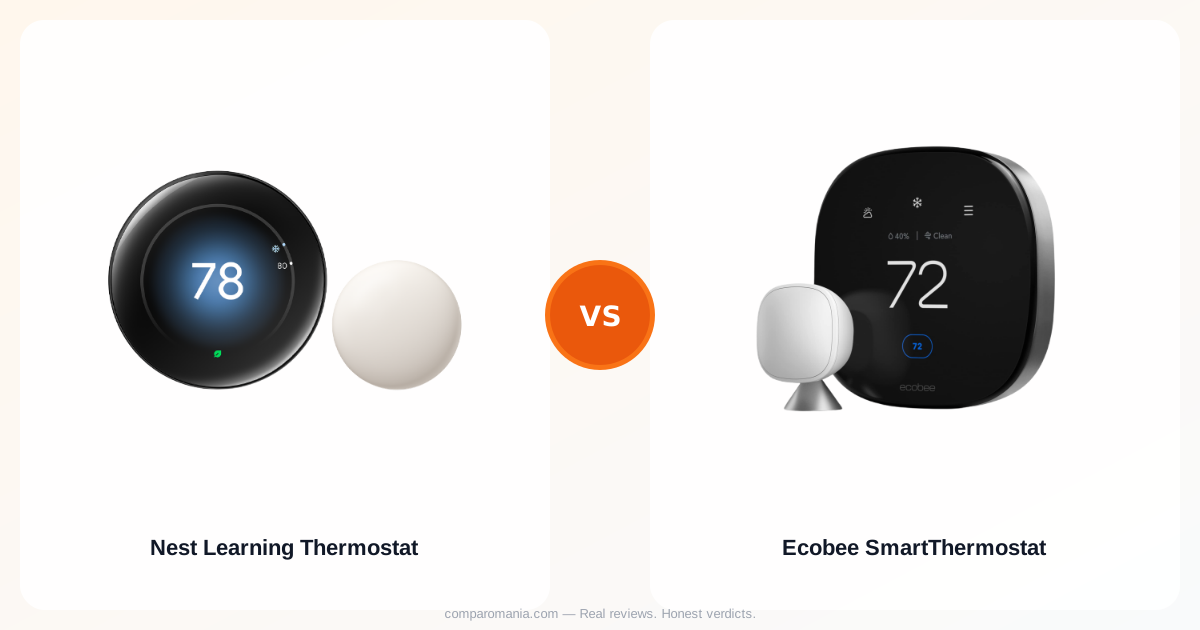
Your smart thermostat worked perfectly for six months, then started heating the house to 78°F while you're at work. The app says it's learning your schedule, but your energy bill suggests it's learned the wrong lessons.
Both Nest and Ecobee promise to automate your heating and cooling while cutting energy costs. Users report savings between 10-15% on average, but the path to those savings differs significantly between the two systems.
Installation Reality Check
Nest installation takes 20-30 minutes if your existing thermostat has a C-wire for continuous power. Without one, you'll need the included Power Connector kit, which adds another 15 minutes of wiring behind your furnace. Most HVAC systems installed after 2000 have the C-wire, but older homes often don't.
Ecobee ships with a Power Extender Kit (PEK) that handles the same C-wire problem but requires more involved wiring at your HVAC unit. Installation typically runs 45 minutes to an hour. The trade-off: Ecobee works with more complex HVAC setups, including heat pumps with auxiliary heating and multi-stage systems that Nest sometimes struggles with.
Both companies offer professional installation for $100-150, but availability varies by region.
Learning vs Manual Control
Nest's selling point is automatic learning — it observes when you adjust the temperature and builds a schedule around your patterns. In practice, this works well for consistent routines but creates problems for irregular schedules. Users with shift work or frequent travel report the system never settles into reliable patterns, constantly second-guessing manual adjustments.
Ecobee takes the opposite approach. You set the schedule manually through the app, then it maintains those settings with minor adjustments based on occupancy sensors. Less magical, more predictable. The system responds to presence but doesn't try to guess your preferences.
The hidden cost of learning systems is the learning period itself. Nest can take 2-4 weeks to establish patterns, during which your energy bills might actually increase as it experiments with different temperatures.
Remote Sensors and Room-by-Room Control
Ecobee includes one remote sensor with the SmartThermostat and supports up to 32 additional sensors at $79 for a two-pack. These sensors read temperature and occupancy in specific rooms, letting the system average temperatures across your house or prioritize occupied rooms.
Nest sensors cost $39 each but only work with the Nest Learning Thermostat (3rd generation) and Nest Thermostat E. They read temperature and occupancy but don't integrate as seamlessly — you can't set the system to prioritize specific rooms during certain hours.
For homes with significant temperature variations between floors or rooms, Ecobee's sensor network provides noticeably more even heating and cooling.
Smart Home Integration
Nest works natively with Google Assistant and integrates well with other Google Nest devices. Amazon Alexa support exists but feels secondary. Apple HomeKit isn't supported at all, which matters if you're invested in Apple's ecosystem.
Ecobee supports Google Assistant, Amazon Alexa, Samsung SmartThings, and Apple HomeKit. The SmartThermostat has Alexa built in, functioning as an Echo Dot with temperature control. Voice responses are clear, and music playback quality is adequate for background listening.
Energy Savings Reality
Both systems claim 10-15% energy savings, but the mechanism differs. Nest achieves savings through schedule learning and auto-away detection when no one's home. Ecobee saves energy through room-specific heating and cooling, avoiding wasted energy on unoccupied areas.
User reports suggest Ecobee delivers more consistent savings in larger homes (2,500+ square feet) while Nest performs better in smaller spaces with predictable occupancy patterns. The difference comes down to whether your energy waste happens from poor scheduling or uneven room temperatures.
App Experience and Reliability
Nest's app is cleaner and more intuitive, with a circular interface that mimics the physical thermostat. Temperature adjustments are smooth, and the energy history provides clear monthly and seasonal comparisons.
Ecobee's app offers more detailed control but requires more setup. You can create complex schedules, set different comfort profiles for different sensors, and access granular energy reports. The interface feels more like software than an appliance.
Connectivity issues affect both systems, but users report Nest losing WiFi connection more frequently, especially after router updates or network changes.
Long-term Costs
Nest thermostats typically last 7-10 years with minimal maintenance. The main failure point is the internal battery, which isn't user-replaceable. Replacement means buying a new unit.
Ecobee units have similar lifespans, but sensor batteries need replacement every 3-4 years at $5 per sensor. For homes with multiple sensors, this adds ongoing costs that aren't obvious upfront.
Both companies provide software updates, but Nest has a better track record of maintaining support for older models.